Showing posts with label Gemstone. Show all posts

Sunday, 19 January 2014

Opal


 The word Opal is adapted from the Roman term opalus, but the origin of this word is a matter of debate. However, most modern references suggest it is adapted from the Sanskrit word úpala.
References to the gem are made by Pliny the Elder. It is suggested it was adapted it fromOps, the wife of Saturn and goddess of fertility. The portion of Saturnalia devoted to Ops was "Opalia", similar to opalus.
Another common claim that the term is adapted from the Greek word, opallios. This word has two meanings, one is related to "seeing" and forms the basis of the English words like "opaque", the other is "other" as in "alias" and "alter". It is claimed that opalus combined these uses, meaning "to see a change in color". However, historians have noted that the first appearances of opallios do not occur until after the Romans had taken over the Greek states in 180 BC, and they had previously used the term paederos.
However, the argument for the Sanskrit origin is strong. The term first appears in Roman references around 250 BC, at a time when the opal was valued above all other gems. The opals were supplied by traders from the Bosporus, who claimed the gems were being supplied from India. Before this the stone was referred to by a variety of names, but these fell from use after 250 BC.

Opal is precious 

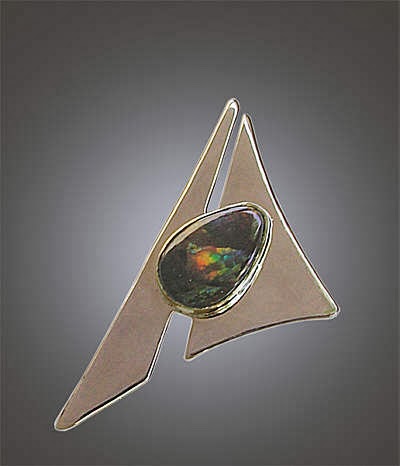
Precious opal shows a variable interplay of internal colors and even though it is a mineraloid, it has an internal structure. At micro scales precious opal is composed of silica spheres some 150 to 300 nm in diameter in a hexagonal or cubic close-packedlattice. These ordered silica spheres produce the internal colors by causing theinterference anddiffraction of light passing through the microstructure of the opal. It is the regularity of the sizes and the packing of these spheres that determines the quality of precious opal. Where the distance between the regularly packed planes of spheres is approximately half the wavelength of a component of visible light, the light of that wavelength may be subject to diffraction from the grating created by the stacked planes. The spacing between the planes and the orientation of planes with respect to the incident light determines the colors observed. The process can be described by Bragg’s Law of diffraction.

Other Varieties of Precious Opal
Fire opals are transparent to translucent opals with warm body colors of yellow, orange, orange-yellow or red. They do not usually show any play of color, although occasionally a stone will exhibit bright green flashes. The most famous source of fire opals is the state of Queretaro in Mexico; these opals are commonly called Mexican fire opals. Fire opals that do not show play of color are sometimes referred to as jelly opals. Mexican opals are sometimes cut in their ryholitic host material if it is hard enough to allow cutting and polishing. This type of Mexican opal is referred to as a Cantera Opal. There is also a type of opal from Mexico referred to as Mexican

Water Opal, which is a colorless opal which exhibits either a bluish or golden internal sheen.
 Girasol opal is a term sometimes mistakenly and improperly used to refer to fire opals as well as a type of transparent to semi-transparent type milky quartz from Madagascar which displays an asterism, or star effect, when cut properly. However, there is a true girasol opal[ that is a type of halite opal, that exhibits a bluish glow or sheen that follows the light source around. It is not a play of color as seen in precious opal but rather an effect from microscopic inclusions. It is also sometimes referred to as water opal as well when it is from Mexico. The two most notable locations of this type of opal are Oregon and Mexico.
Peruvian opal (also called blue opal) is a semi-opaque to opaque blue-green stone found in Peru which is often cut to include the matrix in the more opaque stones. It does not display pleochroism. Blue opal also comes from Oregon in the Owhyee region as well as from Nevada around Virgin Valley.


 Opal Come From -Australia produces around 97% of the world's opal. 90% is called 'light opal' or white andcrystal opal. White makes up 60% of the opal productions but cannot be found in all of the opal fields. Crystal opal or pure hydrated silica makes up 30% of the opal produced, 8% is black and only 2% is boulder opal.
The town ofcoober pedy in South Australia is a major source of opal. The world's largest and most valuable gem opal "Olympic Australis" was found in August 1956 at the "Eight Mile" opal field in Coober Pedy. It weighs 17,000 carats (3450 grams) and is 11 inches (280 mm) long, with a height of 4 3⁄4 inches (120 mm) and a width of 4 1⁄2 inches (110 mm.)
Another source of white base opal or creamy opal in the United States is Spencer, Idaho. A high percentage of the opal found there occurs in thin layers.
Other significant deposits of precious opal around the world can be found in the Czech Republic, Slovakia, Hungary, Turkey, Indonesia, Brazil (in Pedro II ,Piaui), Honduras, Guatemala, Nicaragua and Ethiopia.
In late 2008,NASA announced that it had discovered opal deposits on Mars.


Amethyst


Amethyst is a violet variety of quartz  often used in Jewellery . The name comes from the Ancient Greek  ,a reference to the belief that the stone protected its owner from drunkness  Greek  and Romans wore amethyst and made drinking  vessels of it in the belief that it would prevent intoxication.

Nature 
Amethyst is a purple variety of quartz (SiO2) and owes its violet color to irradiation,iron  impurities (in some cases in conjunction with transition  element impurities), and the presence of trace elements, which result in complex crystal lattice substitutions. The hardness of the mineral is the same as quartz on Mohs Scale it is -7, thus it is suitable for use in jewelry.


Color -
Amethyst occurs in primary hues from a light pinkish violet to a deep purple. Amethyst may exhibit one or both secondary hues, red and blue. The best varieties of Amethysts can be found in Srilanka , Brazil, Africa,Siberia and the far East. The ideal grade is called "Deep Siberian" and has a primary purple hue of around 75–80%, with 15–20% blue and (depend on the light source) red secondary hues.


 Amethyst Belongs to-
Amethyst is produced in abundance from the state of Minas Geris in Brazil where it occurs in large deodes within volcanic rocks . Many of the hollow agates of southwestern Brazil and Urugauay contain a crop of amethyst crystals in the interior. 

 It is also found and mined in South Korea. The largest opencast amethyst vein in the world is in Maissau, Lower Austria. Much fine amethyst comes from Russai, especially from near Mursinka in the Ekaterinburg district, where it occurs in drsy cavities in granitic rocks. Many localities in south India   yield amethyst. One of the largest global amethyst producers is Zambia in southern Africa with an annual production of about 1000 tonnes.

Value -
 Up until the 18th century, amethyst was included in the cardina, or most valuable, gemstones (along with diamond, sapphire, ruby, and emerald). However, since the discovery of extensive deposits in locations such as Brazil, it has lost most of its value.
Collectors look for depth of color, possibly with red flashes if cut conventionally.
 The highest grade amethyst (called "Deep Russian") is exceptionally rare and therefore, when one is found, its value is dependent on the demand of collectors. It is, however, still orders of magnitude lower than the highest grade sapphires or rubies (padparadscha sapphire or "pigeon's blood" ruby).

Wednesday, 1 January 2014

Sapphire


Sapphire in Greek sappheiros, 'blue stone', which probably referred instead at the time to  lapis is a gemstone  variety of the mineral corundum , aluminum (α-Al2O3). Trace amounts of other elements such as iron, titanium, chromium, copper or magnesium can give corundum blue, yellow, purple, orange, or a greenish color. Chromium impurities in corundum yield a pink or red tint, the latter being called a Ruby.
The most valuable color of Sapphire is a cornflower blue color, known as Kashmir.

Sapphire or Cornflower blue Sapphire. Another extremely valuable Sapphire form is the very rare, orange-pink Padparadcchah. An exotic type of sapphire, known as Color Changing Sapphire, displays a different color depending on its lighting. In natural light, Color Changing Sapphire is blue, but in artificial light, it is violet. (This effect is the same phenomenon well-known in the gemstone Alexandrite). Yellow and pink Sapphire have recently become very popular, and are now often seen in jewelry.


Sapphire often contains minor inclusions of tiny slender Rutile needles. When present, these inclusions decrease the transparency of a stone and are known as silk. When in dense, parallel groupings, these inclusions can actually enhance by allowing polished Sapphires to exhibit asterism. Sapphire gems displaying asterism are known as "Star Sapphire", and these can be highly prized. Star Sapphire exists in six ray stars, though twelve ray stars are also known.

Sapphire is pleochroic  , displaying a lighter and more intense color when viewed at different angles. Some pleochroic Sapphire is blue when viewed at one angle, and purple at a different angle. Color zoning, which forms from growth layers that build up during the formation of the stone, may also be present in certain Sapphires. Color zoning is responsible for certain Sapphires having lighter and darker colors in different parts of a crystal. Some Sapphire gemstones may even be multicolored such as purple and blue.

Sapphire is a tough and durable gem and the only natural gemstone harder than Sapphire is Diamond. Despite this, Sapphire is still subject to chipping and fracture if handled roughly, and care should be taken to ensure it is properly handled. Sapphire was first synthesized in 1902. The process of creating synthetic Sapphire is known as the Verneuil process Only experts can distinguish between natural and synthetic Sapphire.


Source of color
Rubies are corundum which contains chromium impurities that absorb yellow-green light and result in deeper ruby red color with increasing content. Purple sapphires contain trace amounts of vanadium and come in a variety of shades. Corundum that contains ~0.01% of titanium   is colorless. If trace amounts of iron i are present, a very pale yellow to green color may be seen. If both titanium and iron impurities are present together, however, the result is a magnificent deep-blue color.
 Unlike localized ("intra-atomic") absorption of light which causes color for chromium and vanadium impurities, blue color in sapphires comes from intervalence charge transfer, which is the transfer of an electron from one transition-metal ion to another via the conduction or valence band. The iron can take the form Fe2+ or Fe3+, while titanium generally takes the form Ti4+. If Fe2+ and Ti4+ions are substituted for Al3+, localized areas of charge imbalance are created. An electron transfer from Fe2+ and Ti4+ can cause a change in the valence state of both. Because of the valence change there is a specific change in energy for the electron, and electromanetic energy is absorbed. The wavelength of the energy absorbed corresponds to yellow light. When this light is subtracted from incident white light, the complementary color blue results. Sometimes when atomic spacing is different in different directions there is resulting blue-green dichroism.
Intervalence charge transfer is a process that produces a strong colored appearance at a low percentage of impurity. While at least 1% chromium must be present in corundum before the deep red ruby color is seen, sapphire blue is apparent with the presence of only 0.01% of titanium and iron.

Treatments

Sapphires may be treated by several methods to enhance and improve their clarity and color; It is normally done by heat treatment. Heating the sapphires in furnaces to temperatures between 500 and 1800 °C for several hours or by heating in a nitrogen-deficient atmosphere oven for seven days or more is the common process. Upon heating, the stone becomes bluer in color, but loses some of the rutile inclusions (silk).  Un-heated natural stones are somewhat rare and will often be sold accompanied by a certificate from an independent gemological laboratory attesting to "no evidence of heat treatment.
"Yogo sapphire sometimes do not need heat treating because their cornflower blue coloring is uniform and deep, they are generally free of the characteristic inclusions, and they have high uniform clarity. At that time, 95% of all the world's sapphires were being heated to enhance their natural color.
 Diffusion treatments are used to add impurities to the sapphire to enhance color. Typically beryllium is diffused into a sapphire under very high heat, just below the melting point of the sapphire. Initially (c. 2000) orange sapphires were created, although now the process has been advanced and many colors of sapphire are often treated with beryllium. The colored layer can be removed when stones chip or are repolished or refaceted, depending on the depth of the impurity layer. Treated padparadschas may be very difficult to detect, and many stones are certified by gemological labs.

 Transparency and hardness
One application of synthetic sapphire is sapphire glass. Here glass is a layman term which refers not to the amorphous state, but to the transparency. Sapphire is not only highly transparent to wavelengths of light between 150 nm (UV) and 5500 nm (IR) (the human eye can discern wavelengths from about 380 nm to 750 nm), but is also extraordinarily scratch-resistant. Sapphire has a value of 9 on the Mohs scale of mineral hardness.


 Sapphire Comes From:-
Important Sapphire sources include Sri Lanka, Burma (Myanmar), Thailand, Cambodia, Madagascar, Tanzania, Australia, and the U.S. (Montana). The Kashmir region of India/Pakistan was famous for its Kashmir-blue Sapphire, but little material comes from there today.


Wednesday, 25 December 2013

Ruby

Ruby


Which color would you spontaneously associate with love and vivacity, passion and power? It's obvious, isn't it? Red. Red is the color of love. It radiates warmth and a strong sense of vitality. And red is also the color of the ruby, the king of the gemstones. In the fascinating world of gemstones, the ruby is the undisputed ruler.

For thousands of years, the ruby has been considered one of the most valuable gemstones on Earth. It has everything a precious stone should have: magnificent color, excellent hardness and outstanding brilliance. In addition to that, it is an extremely rare gemstone, especially in its finer qualities.


For a long time India was regarded as the ruby's classical country of origin. In the major works of Indian literature, a rich store of knowledge about gemstones has been handed down over a period of more than two thousand years. The term 'corundum', which we use today, is derived from the Sanskrit word 'kuruvinda'. The Sanskrit word for ruby is 'ratnaraj', which means something like 'king of the gemstones'. And it was a royal welcome indeed which used to be prepared for it. Whenever a particularly beautiful ruby crystal was found, the ruler sent high dignitaries out to meet the precious gemstone and welcome it in appropriate style. Today, rubies still decorate the insignia of many royal households. But are they really all genuine rubies? Read on to find out more!


Only a little bit of chrome (Physical properties) ...

Rubies have a hardness of 9.0 on the Mohs scale of mineral hardness. 
Ruby is α-alumina (the most stable form of Al2O3) in which a small fraction of the aluminium3+ ions are replaced by chromium3+ ions. Each Cr3+ is surrounded octahedrally by six O2- ions. 
This crystallographic arrangement strongly affects each Cr3+, resulting in light absorption in the yellow-green region of the spectrum and thus in the red color of the gem. 
When yellow-green light is absorbed by Cr3+, it is re-emitted as red luminescence this red emission adds to the red color perceived by the subtraction of green and violet light from white light, and adds luster to the gem's appearance. When the optical arrangement is such that the emission is stimulated by 694-nano meter photons reflecting back and forth between two mirrors, the emission grows strongly in intensity. This effect was used by Theodore Maiman in 1960 to make the first successful laser, based on ruby.

All natural rubies have imperfections in them, including color impurities and inclusions of rutile needles known as "silk". Gemologists use these needle inclusions found in natural rubies to distinguish them from synthetics, simulants, or substitutes. Usually the rough stone is heated before cutting. Almost all rubies today are treated in some form, with heat treatment being the most common practice. However, rubies that are completely untreated but still of excellent quality command a large premium.
Some rubies show a three-point or six-point asterism or "star". These rubies are cut into cabochons to display the effect properly. Asterisms are best visible with a single-light source, and move across the stone as the light moves or the stone is rotated. Such effects occur when light is reflected off the "silk" (the structurally oriented rutile needle inclusions) in a certain way. This is one example where inclusions increase the value of a gemstone. Furthermore, rubies can show color changes—though this occurs very rarely—as well as chatoyancy or the " cat's eye " effect. 

Color

Generally, gemstone-quality corundum in all shades of red, including pink, is called rubies. However, in the United States, minimum color saturation must be met to be called a ruby; otherwise the stone will be called a pink sapphire. 
This distinction between rubies and pink sapphires is relatively new, having arisen sometime in the 20th century. If a distinction is made, the line separating a ruby from a pink sapphire is not clear and highly debated. 
As a result of the difficulty and subjectiveness of such distinctions, trade organizations such as the International Colored Gemstone Association (ICA) have adopted the broader definition for ruby which encompasses its lighter shades, including pink.

Natural occurrence-

The Mogok Valley in Myanmar (Burma) was for centuries the world's main source for rubies. That region has produced some of the finest rubies, but in recent years very few good rubies have been found there. The very best color in Myanmar rubies is sometimes described as "pigeon's blood. The most recently found ruby deposit in Myanmar is in Namya (Namyazeik) located in the northern state of Kachin.
Rubies have historically been mined in Thailand, the Pailin and Samlout
Districts of Cambodia, Burma,India, Afganistan and inPakistan. In Srilanka, lighter shades of rubies (often "pink sapphires") are more commonly found.  Ruby deposits were also found in Tanzania,Madagaskar, Vietnam, Nepal,Tajikistan, and Pakistan.

More recently,large ruby deposits have been found under the receding ice shelf of Greenland.

Spinal, another red gemstone, is sometimes found along with rubies in the same gem gravel or marble. Red spinel may be mistaken for ruby by those lacking experience with gems. However, the finest red spinels can have a value approaching that of the average ruby. The color of rubies varies from vermilion to red. The most desired color is "pigeon's blood", which is pure red with a hint of blue. If the color is too pink, the stone is a pink sapphire. The same is true if it is too violet – it is a violet sapphire. The best rubies and star rubies are bright red. Most rubies come from Burma and Thailand.


Treatments and enhancements

Improving the quality of gemstones by treating them is common practice. Some treatments are used in almost all cases and are therefore considered acceptable. During the late 1990s, a large supply of low-cost materials caused a sudden surge in supply of heat-treated rubies, leading to a downward pressure on ruby prices.
Improvements used include color alteration, improving transparency by dissolving rutile inclusions, healing of fractures (cracks) or even completely filling them.
The most common treatment is the application of heat. Most, if not all, rubies at the lower end of the market are heat treated on the rough stones to improve color, remove purple tinge, blue patches and silk. These heat treatments typically occur around temperatures of 1800 °C (3300 °F). Some rubies undergo a process of low tube heat, when the stone is heated over charcoal of a temperature of about 1300 °C (2400 °F) for 20 to 30 minutes. The silk is only partially broken as the color is improved.
Another treatment, which has become more frequent in recent years, is lead glass filling. Filling the fractures inside the ruby with lead glass (or a similar material) dramatically improves the transparency of the stone, making previously unsuitable rubies fit for applications in jewelry. The process is done in four steps:

Factors affecting value-

Diamonds are graded using criteria that have become known as the four Cs, namely color, cut, clarity and carat weight. Similarly natural rubies can be evaluated using the four Cs together with their size and geographic origin.
Color: In the evaluation of colored gemstones, color is the most important factor. Color divides into three components; hue, saturation and tone. Hue refers to "color" as we normally use the term. Transparent gemstones occur in the following primary hues: red, orange, yellow, and green, blue, violet. These are known as pure spectral hues. In nature there are rarely pure hues so when speaking of the hue of a gemstone we speak of primary and secondary and sometimes tertiary hues. In ruby the primary hue must be red. All other hues of the gem species corundum are called sapphire. Ruby may exhibit a range of secondary hues. Orange, purple, violet and pink are possible.

Tuesday, 24 December 2013

Emerald

Emeralds


Emeralds are fascinating gemstones. They have the most beautiful, most intense and most radiant green that can possibly be imagined: emerald green. Inclusions are tolerated. In top quality, fine emeralds are even more valuable than diamonds.
The name emerald comes from the Greek 'smaragdos' via the Old French 'esmeralde', and really just means 'green gemstone'.

Emeralds, like all colored gemstone are graded using four basic parameters–the four Cs of Connoisseurship: Color, Cut, Clarity and Crystal. The last C, crystal, is simply a synonym for transparency.

The world of fine emeralds

Colombia continues to be at the top of the list in terms of the countries in which fine emeralds are found. It has about 150 known deposits, though not all of these are currently being exploited. 

The best known names are Muzo and Chivor, where emeralds were mined by the Incas in pre-Columbian times. In economic terms, the most important mine is at Coscuez, where some 60 faces are being worked. 

According to estimates, approximately three quarters of Colombia's emerald production now comes from the Coscuez Mine. Colombian emeralds differ from emeralds from other deposits in that they have an especially fine, shining emerald green unimpaired by any kind of bluish tint. The colour may vary slightly from find to find. This fascinatingly beautiful colour is so highly esteemed in the international emerald trade that even obvious inclusions are regarded as acceptable.

But Colombia has yet more to offer: now and then the Colombian emerald mines throw up rarities such as Trapiche emeralds with their six rays emanating from the centre which resemble the spokes of a millwheel.

Even if many of the best emeralds are undisputedly of Colombian origin, the 'birthplace' of a stone is never an absolute guarantee of its immaculate quality. Fine emeralds are also found in other countries, such as Zambia, Brazil, Zimbabwe, Madagascar, Pakistan, India, Afghanistan and Russia. Zambia, Zimbabwe and Brazil in particular have a good reputation for fine emeralds in the international trade. 

Excellent emerald crystals in a beautiful, deep emerald green and with good transparency come from Zambia. Their colour is mostly darker than that of Colombian emeralds and often has a fine, slightly bluish undertone. 

Emeralds which are mostly smaller, but very fine, in a vivacious, intense green come from Zimbabwe's famous Sandawana Mine, and they often have a delicate yellowish-green nuance. And the famous emerald mines of Colombia currently face competition from right next door: Brazil's gemstone mine Nova Era also produces emeralds in beautiful green tones, and if they are less attractive than those of their famous neighbour it is only by a small margin. 

Brazil also supplies rare emerald cat's eyes and extremely rare emeralds with a six-spoked star. Thanks to the finds in Africa and Brazil, there are more emeralds on the market now than there used to be - to the delight of emerald enthusiasts - .


Color

In gemology, color is divided into three components:hue,saturation& tone. Emeralds occur in hues ranging from yellow-green to blue-green, with the primary hue necessarily being green. Yellow and blue are the normal secondary hues found in emeralds. Only gems that are medium to dark in tone are considered emerald; light-toned gems are known instead by the species name green beryl.

 The finest emerald are approximately 75% tone on a scale where 0% tone would be colorless and 100% would be opaque black. In addition, a fine stone should be well saturated; the hue of an emerald should be bright (vivid). Gray is the normal saturation modifier or mask found in emerald; a grayish-green hue is a dull green hue


Clarity

Emerald tends to have numerous inclusions and surface breaking fissures. Unlike diamond, where the loupe standard, i.e. 10× magnification, is used to grade clarity, emerald is graded by eye. Thus, if an emerald has no visibleinclusion to the eye (assuming normal visual acuity) it is considered flawless.

Stones that lack surface breaking fissures are extremely rare and therefore almost all emeralds are treated ("oiled", see below) to enhance the apparent clarity. Eye-clean stones of a vivid primary green hue (as described above) with no more than 15% of any secondary hue or combination (either blue or yellow) of a medium-dark tone command the highest prices. 

This relative crystal non-uniformity makes emeralds more likely than other gemstones to be cut intocabpchons, rather than faceted shapes.


Treatments


Most emeralds are oiled as part of the post-lapidary process, in order to improve their clarity. Cedar oil, having a similar refractive index, is often used in this generally accepted practice. Other liquids, including synthetic oils and polymers with refractive indexes close to that of emerald such as Opticon are also used. 

The world of fine emeralds

Even if many of the best emeralds are undisputedly of Colombian origin, the 'birthplace' of a stone is never an absolute guarantee of its immaculate quality. Fine emeralds are also found in other countries, such as Zambia, Brazil, Zimbabwe, Madagascar, Pakistan, India, Afghanistan and Russia. 

Zambia, Zimbabwe and Brazil in particular have a good reputation for fine emeralds in the international trade. Excellent emerald crystals in a beautiful, deep emerald green and with good transparency come from Zambia. Their colour is mostly darker than that of Colombian emeralds and often has a fine, slightly bluish undertone.

Emeralds which are mostly smaller, but very fine, in a vivacious, intense green come from Zimbabwe's famous Sandawana Mine, and they often have a delicate yellowish-green nuance. 

And the famous emerald mines of Colombia currently face competition from right next door: Brazil's gemstone mine Nova Era also produces emeralds in beautiful green tones, and if they are less attractive than those of their famous neighbour it is only by a small margin.

Brazil also supplies rare emerald cat's eyes and extremely rare emeralds with a six-spoked star. Thanks to the finds in Africa and Brazil, there are more emeralds on the market now than there used to be - to the delight of emerald enthusiasts - . 


Emerald in different cultures, and emerald lore

Emerald is regarded as the traditional birthstone for May, as well as the traditional gemstone for the astrological sign of Taurus , Gemini and sometimes Cancer.